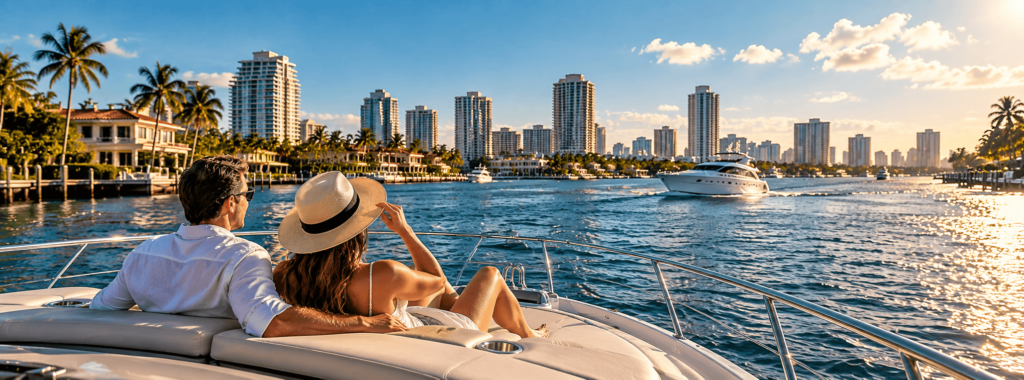
Boating in winter is the reason South Florida fills up from December through April. The air is dry, the afternoon thunderstorms of summer are gone, and a day on the Intracoastal Waterway (ICW) stays comfortable from the first hour to the last. That does not make every day easy. Cold fronts change the sea state fast, daylight runs about 10½ hours, and the water is cooler than most visitors expect.
Here is what winter boating in Florida looks like from the helm in Fort Lauderdale: the conditions to plan around, winter boating tips that prevent a bad day, how the main winter boating destinations compare, and how to book a captained charter before the good dates are gone.
Why Boating in Winter Works in South Florida
South Florida’s dry season runs roughly November through April. Humidity drops, the daily storm cycle that defines summer boating stops, and the light is clear enough that sunsets and skyline photos look sharper than they do in August. Typical winter air temperatures are in the 70s during the day and the 60s in the early morning and after dark.
That is a reversal of the summer pattern. In July, the smart move is a morning departure and a return before the afternoon storms build. In winter, a full day works. A 4 to 6 hour charter is easy to enjoy, and an evening cruise stays comfortable well after sunset with a light jacket.
It is also the busy season. Seasonal residents return, restaurants along the water fill up, and charter demand peaks. At Lauderdale Charters, peak-season weekends typically book 4 to 6 weeks out, so the best dates go first.
Winter Boating in Florida: What the Water Is Like
Check these before you pick a date.
| Condition | Typical winter pattern | What it means for your day |
|---|---|---|
| Air temperature | Highs in the 70s, mornings and evenings in the 60s | Bring a layer. Wind at cruising speed feels cooler than the number on your phone |
| Water temperature | Low to mid 70s | A quick swim works for some guests, but most find it cold. Treat the swim stop as optional |
| Daylight | About 10½ hours in late December, sunset near 5:30 PM | Start earlier, and plan sunset trips for mid-afternoon departures |
| Rain | Dry season, with short showers when a front passes | Check the forecast the day before. Captains reschedule when conditions call for it |
| Wind | Shifts north and northeast behind a front | Chop offshore, noticeably calmer inside on the ICW |
Cold fronts decide the day
Through the winter, a front passes every week or two. When it does, the wind swings around to the north and builds. Offshore, the Gulf Stream runs north, and wind blowing against that current stacks up short, steep seas. At the Port Everglades inlet, a north wind against an outgoing tide makes the same problem worse.
That is why a captain may keep a front-day charter on the ICW and along Millionaires’ Row, where the water stays protected, and save the offshore swim stop for the settled days on either side. The days after a front often turn out light-wind and clear. The call belongs to the captain, and a good operator makes it early and tells you why.
Winter Boating Tips From the Helm
These are the winter boating tips that matter most in Fort Lauderdale.
- Read the marine forecast, not just the weather app. The National Weather Service marine forecast for the Atlantic coastal waters gives wind direction, wind speed and seas. A small craft advisory means the offshore plan changes.
- Dress in layers. A windbreaker over a t-shirt covers most winter days. Sunscreen still applies, since the winter sun is strong over open water.
- Plan around sunset. With sunset near 5:30 PM in December, a 4-hour day trip that starts at noon ends in golden light. A later start means finishing in the dark.
- Make the swim optional. Water in the low 70s is refreshing for some and a hard no for others. Build the itinerary so the day works without it.
- Wear non-marking, grippy shoes. Winter decks stay damp longer in the morning.
- Give manatees room. Manatees gather in warmer water when it cools, and seasonal slow-speed zones are posted on parts of Broward’s waterways. Your captain runs them; if you are on your own boat, watch the signs.
- Expect event traffic. Boat show season in the fall and the Winterfest Boat Parade in December put a lot of vessels on the same stretch of water.
- If you bring your own boat, add time. Some ICW bridges open on a schedule rather than on demand, which stretches a route. Florida also requires a boater safety ID card for anyone born on or after January 1, 1988 who operates a boat with 10 horsepower or more.
- Book early. December through April is the peak window, and holiday weeks go first.
Winter Boating Destinations in Florida
Florida has several good winter boating destinations. Here is how the main ones compare:
- Florida Keys. Clear water and reef access, with John Pennekamp Coral Reef State Park in Key Largo as the best-known stop for snorkeling and diving. It is a long drive south, so trips tend to be multi-day.
- Southwest Florida (Sanibel, Cayo Costa, Naples). Calmer water behind the barrier islands, shelling, and sunsets over the Gulf. Winter fronts hit the Gulf side too, so wind direction still matters.
- Crystal River. The winter destination for manatee viewing, when the animals concentrate in the warm spring-fed water. It is a nature trip, not a cruising day.
- The Bahamas. A short hop on a map and a serious one on the water. The Gulf Stream crossing needs a settled weather window and an experienced crew, so it is not a casual day trip.
- Fort Lauderdale. Protected ICW water for windy days, an inlet and open Atlantic for settled ones, restaurants and marinas that work as stops, and one of the largest concentrations of charter vessels in the country.
For a visitor with a week and no boat, Fort Lauderdale is the easiest of these to book and the most flexible to plan, because the same city offers both the protected-water day and the offshore day.
Boating in Winter in Fort Lauderdale: Four Ways to Spend the Day
The ICW and Millionaires’ Row
The protected-water classic, and the right call on a windy day. The route runs the Intracoastal and the New River past waterfront estates and yachts. Millionaires’ Row is not a single street. It refers to the stretches of luxury waterfront homes along the New River, Las Olas Isles and the Intracoastal. Plan 3 to 4 hours.
Port Everglades inlet and an offshore swim stop
On a settled day, the route exits the inlet and anchors off the reef for clear water and a swim stop. This is the format that depends most on the forecast, and it is the one a captain will move to another day if the seas are wrong. A yacht charter in Fort Lauderdale gives you the room and range for this one.
Sunset on the water
Winter sunsets arrive early, which makes this the easiest trip to fit around dinner. Departures are timed to the sunset window for that specific day, not a fixed hour. See the sunset charter guide for how the timing works.
Holiday lights in December
From around Thanksgiving through New Year’s, the waterfront homes and boats light up, and the best view of them is from the water.
If your group wants an open-air deck for any of these, ask about a pontoon boat rental in Fort Lauderdale. The ICW is a good fit for a pontoon on winter days when the wind stays moderate.
How to Book a Winter Charter
Booking for boating in winter follows the same steps as any charter, with a few winter-specific questions:
- Give four details up front: date, group size, duration and occasion. Private charters here carry up to 13 guests.
- Ask about the forecast plan. What happens if a front moves in? Who makes the call, and what happens to the deposit?
- Ask for the vessel name and current photos. Not a hero image from the website.
- Ask who the captain is. A licensed captain should be able to give you a license number when you ask.
- Plan your food and drinks. Lauderdale Charters does not provide onboard catering. Guests bring their own, and we can point you to local caterers who prepare boat-friendly packages.
- Book 4 to 6 weeks ahead for peak-season weekends and holiday weeks. For a first-time charter, read [how to rent a yacht in Fort Lauderdale [L2]] and [how much it costs to rent a yacht for a day [L3]] before you call.
Plan Your Winter Day on the Water
Boating in winter in Fort Lauderdale comes down to four things: a layer, a forecast check, a swim you can skip, and a captain who knows how to read a front. Send us your date, group size and what you want to do, and we will pick a boat that fits your group and a route that suits that day’s wind. Book your winter boating day and enjoy the Florida cool breeze.
Frequently Asked Questions
Is winter a good time for boating in Florida?
Yes. The dry season brings low humidity, steady light and far fewer storms than summer. The trade-offs are shorter days, cooler water, and cold fronts that can make the offshore Atlantic rough for a day or two.
Is the water too cold to swim in Fort Lauderdale in winter?
Water temperatures in the low to mid 70s are comfortable for a short swim for some guests and too cold for others. Plan the day so the swim is optional, and bring a towel and a layer for afterward.
What should I wear boating in winter in South Florida?
Layers. A t-shirt, a windbreaker or light jacket, non-marking shoes and sunscreen cover most days. Evening and early-morning trips are noticeably cooler than midday.
Are winter conditions rougher in Fort Lauderdale?
Only around cold fronts. Behind a front, north wind against the Gulf Stream builds seas offshore, while the ICW stays protected. Captains adjust the route, which is why a flexible itinerary matters more than a fixed one.
When should I book a winter charter?
For peak-season weekends and holiday weeks, 4 to 6 weeks ahead. Weekdays in the shoulder months of October and November are easier to get on short notice.